
Austria
Austria sits at the geographic heart of Europe, a landlocked country of Alpine peaks, river valleys, and Baroque city centres where classical music remains woven into the texture of everyday life.
Overview
Bordering eight countries — Germany, Czech Republic, Slovakia, Hungary, Slovenia, Italy, Switzerland, and Liechtenstein — Austria covers roughly 83,871 km² in Central Europe. Vienna, the capital, sits on the Danube in the northeast and serves as the country's political and cultural centre. German is the official language, and the euro is the currency. Austria is a federal parliamentary republic with a cultural identity shaped heavily by its Habsburg imperial past, coffee-house tradition, and Alpine rural life.
Visa Requirements
Austria is a member of the Schengen Area, meaning travellers from many countries can enter visa-free for stays up to 90 days within any 180-day period. Those requiring a visa apply through the standard Schengen visa process. The EU's forthcoming ETIAS authorisation system will apply to Austria once operational. Always verify current requirements through your home country's consulate.
Airports in Austria
6 airportsAirlines based in Austria
5 airlines


Famous Attractions in Austria
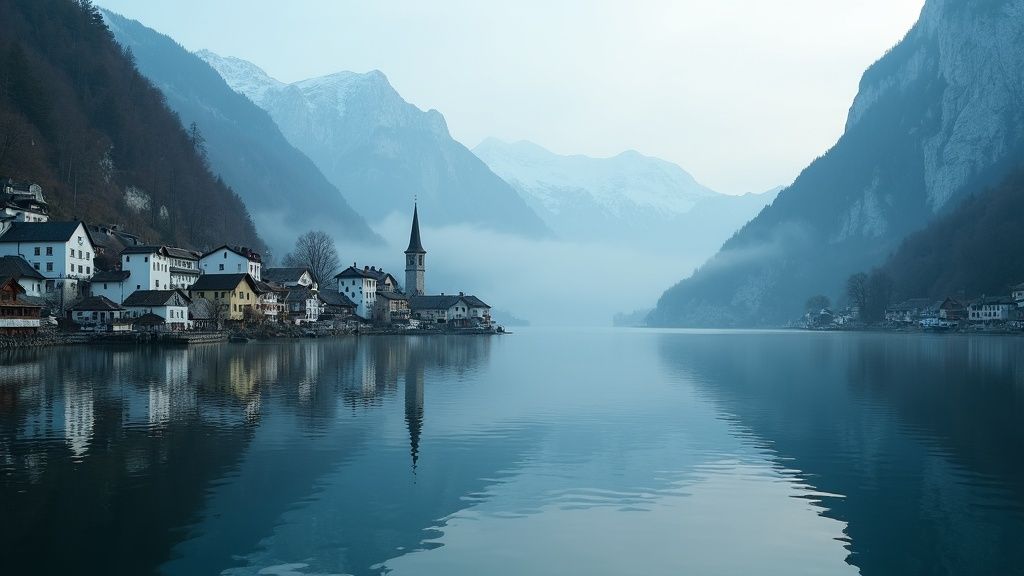
The Schönbrunn Palace in Vienna, a UNESCO-listed Baroque complex with 1,441 rooms, draws visitors year-round. Salzburg's historic old town, birthplace of Mozart, is itself a UNESCO World Heritage Site. The Hallstatt lakeside village in the Salzkammergut is one of the oldest continuously inhabited settlements in Europe. Vienna's Kunsthistorisches Museum holds one of the great art collections on the continent. The Grossglockner High Alpine Road offers a dramatic crossing of the central Alps at 2,504 metres.
Weather & Climate
Austria has a temperate continental climate with regional variation. Vienna summers average 24–26 °C, while winters drop to around 0 to −3 °C. Alpine regions receive heavy snowfall from November through March, making them the base for winter sports. Spring and early autumn — roughly April to June and September to October — offer mild temperatures and fewer crowds. Pack layers regardless of season; mountain weather shifts quickly.
Interesting Facts About Austria
- Red Bull was founded in Austria in 1987.
- Austria produced composers Mozart, Haydn, and Schubert.
- The country has zero coastline despite a historic naval tradition.
- Hallstatt gave its name to an Iron Age archaeological culture.
- Austria was the last country to join the EU in 1995 among its wave.
Official Resources
- austria.info — Austrian National Tourist Office, official visitor information
- bmi.gv.at — Federal Ministry of the Interior, visa and entry regulations
- bmk.gv.at — Federal Ministry for Climate Action, transport policy and rail network
- zamg.ac.at — GeoSphere Austria, national meteorological and climate service
- oebb.at — Austrian Federal Railways, national rail timetables and tickets