Faroe Islands
Eighteen volcanic islands perched in the North Atlantic between Norway and Iceland, the Faroe Islands are defined by steep sea cliffs, narrow fjords, turf-roofed villages, and an almost perpetual Atlantic wind that shapes everything from the grass to the pace of daily life.
Overview
The Faroe Islands form a self-governing archipelago within the Kingdom of Denmark, situated roughly equidistant between Scotland, Iceland, and Norway. The capital, Tórshavn, is one of the world's smallest capitals. Faroese and Danish are the official languages, and the currency is the Faroese króna, which is pegged to and interchangeable with the Danish krone. The islands sustain a small population of around 55,000, with fishing and aquaculture anchoring the economy and a strong oral and musical folk tradition running through the culture.
Visa Requirements
The Faroe Islands are not part of the European Union or the Schengen Area, but have a separate agreement allowing passport-free travel for Schengen and Nordic citizens. Many nationalities — including EU, US, UK, Canadian, and Australian passport holders — may enter without a visa for short stays. Travellers should verify current entry requirements through official Faroese authorities before travel, as conditions can differ from standard Danish or EU rules.
Airports in Faroe Islands
1 airportAirlines based in Faroe Islands
1 airline
Famous Attractions in Faroe Islands
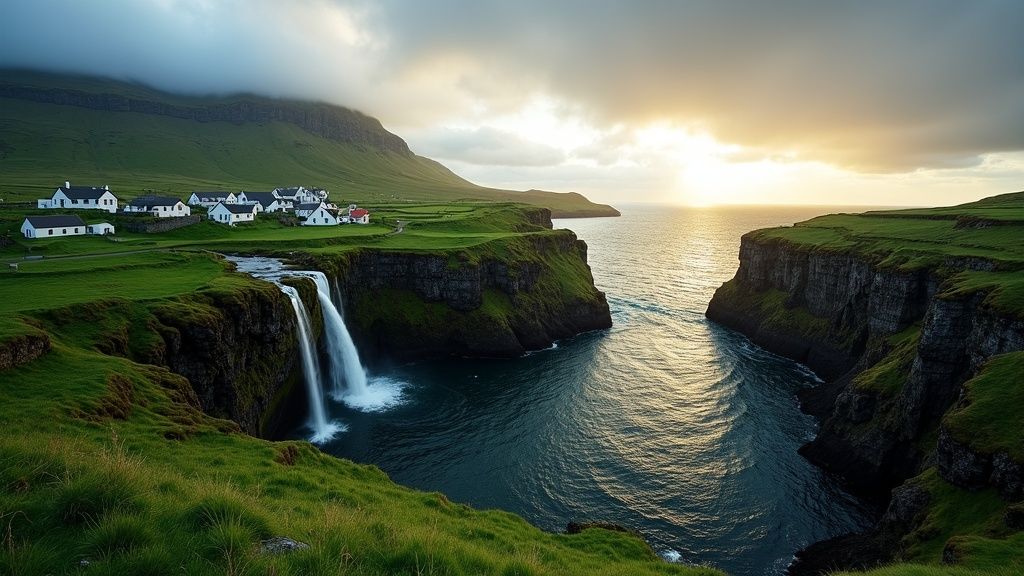
The cliffs of Vestmanna on Streymoy island rise vertically from the sea and shelter seabird colonies accessible by boat. Lake Sørvágsvatn on Vágar creates an optical illusion, appearing to hover above the ocean from certain vantage points. The village of Gásadalur, reached through a mountain tunnel, sits beside a waterfall that drops directly into the sea. Kirkjubøur, on the southwestern tip of Streymoy, holds the ruins of the 13th-century St. Magnus Cathedral. The lighthouse at Akraberg on Suðuroy marks the southernmost point of the archipelago.
Weather & Climate
The Faroe Islands have a subpolar oceanic climate, kept mild year-round by the Gulf Stream but rarely warm. Summer temperatures typically range from 10 °C to 14 °C, while winters hover between 3 °C and 7 °C — rarely freezing but often grey, wet, and windy. The most stable weather falls between June and August. Fog and low cloud are common throughout the year, and conditions can shift rapidly within a single day. Layered, waterproof clothing is essential at any time of year.
Interesting Facts About Faroe Islands
- Tórshavn is among the world's smallest capital cities.
- The islands have more sheep than human inhabitants.
- Faroese was a purely oral language until 1846.
- No trees grow natively on the archipelago.
- The islands hold associate membership in UEFA and FIFA.
Official Resources
- faroeislands.fo — official tourism portal run by Visit Faroe Islands
- gov.fo — portal for the Government of the Faroe Islands
- smf.fo — Faroese Meteorological Agency weather information
- ssl.fo — Strandfaraskip Landsins, the national ferry and bus operator