
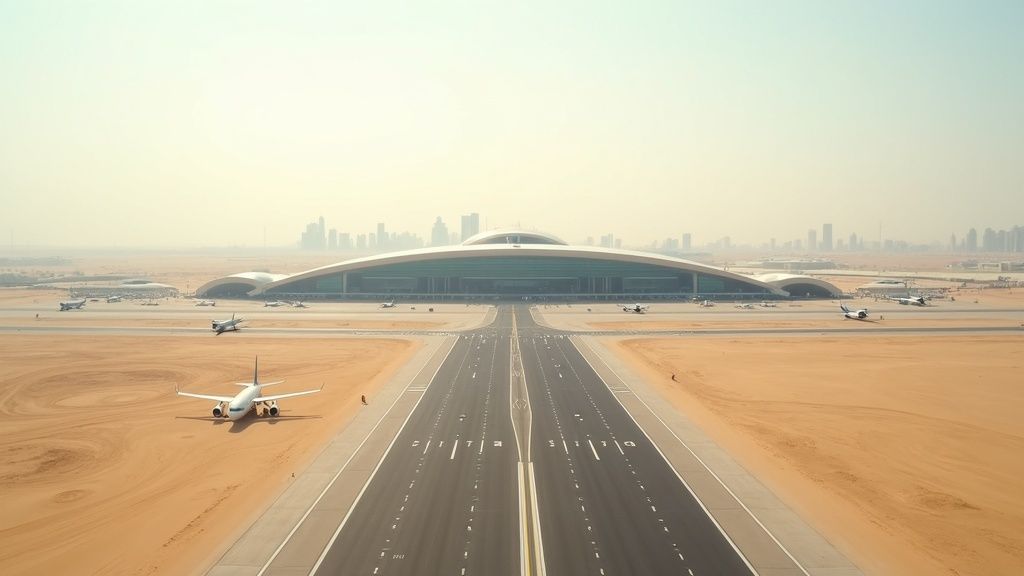
Abu Dhabi International Airport
About Abu Dhabi International Airport
Overview
Abu Dhabi International Airport lies approximately 30 kilometres east of central Abu Dhabi, serving as the primary international gateway to the capital of the United Arab Emirates. It opened in 1982, replacing the older Al Bateen Airport, which had grown unsuitable for large commercial jets. The airport functions as a major long-haul hub linking the Gulf region with Europe, Asia, Africa, and the Americas.
Terminals & runways
The airport currently operates from Terminal A, a large unified terminal opened in 2023 that consolidated operations from the older Terminals 1, 2, and 3. Two parallel runways oriented roughly 13/31 handle traffic around the clock, with no overnight curfew. Terminal A is among the largest single airport buildings in the world and was designed to significantly expand the airport's overall capacity.
Airlines
Abu Dhabi International is the principal hub of Etihad Airways, the UAE's flag carrier, which operates the bulk of long-haul services from the airport. Low-cost carrier Wizz Air Abu Dhabi also bases aircraft here. A wide range of international carriers from Europe, the Indian subcontinent, Southeast Asia, and the Gulf region serve the airport with scheduled passenger and cargo flights.
Airlines flying from AUH
6 carriersTop routes from AUH
1 routeOther airports in United Arab Emirates
FAQ
Abu Dhabi International Airport — frequently asked questions
- Where is Abu Dhabi International Airport?
- Abu Dhabi International Airport is located in Abu Dhabi, United Arab Emirates (Asia), at coordinates 24.430°, 54.650°.
- What is the airport code for Abu Dhabi International Airport?
- Its IATA code is AUH and its ICAO code is OMAA.
- What time zone is AUH in?
- Abu Dhabi International Airport operates on Asia/Dubai local time.
- Which airlines fly from AUH?
- Carriers tracked on routes from AUH include American Airlines, Etihad Airways, Iberia, Air India Express, Lufthansa and Oman Air.
- Where can you fly from AUH?
- Tracked destinations from AUH include Muscat.